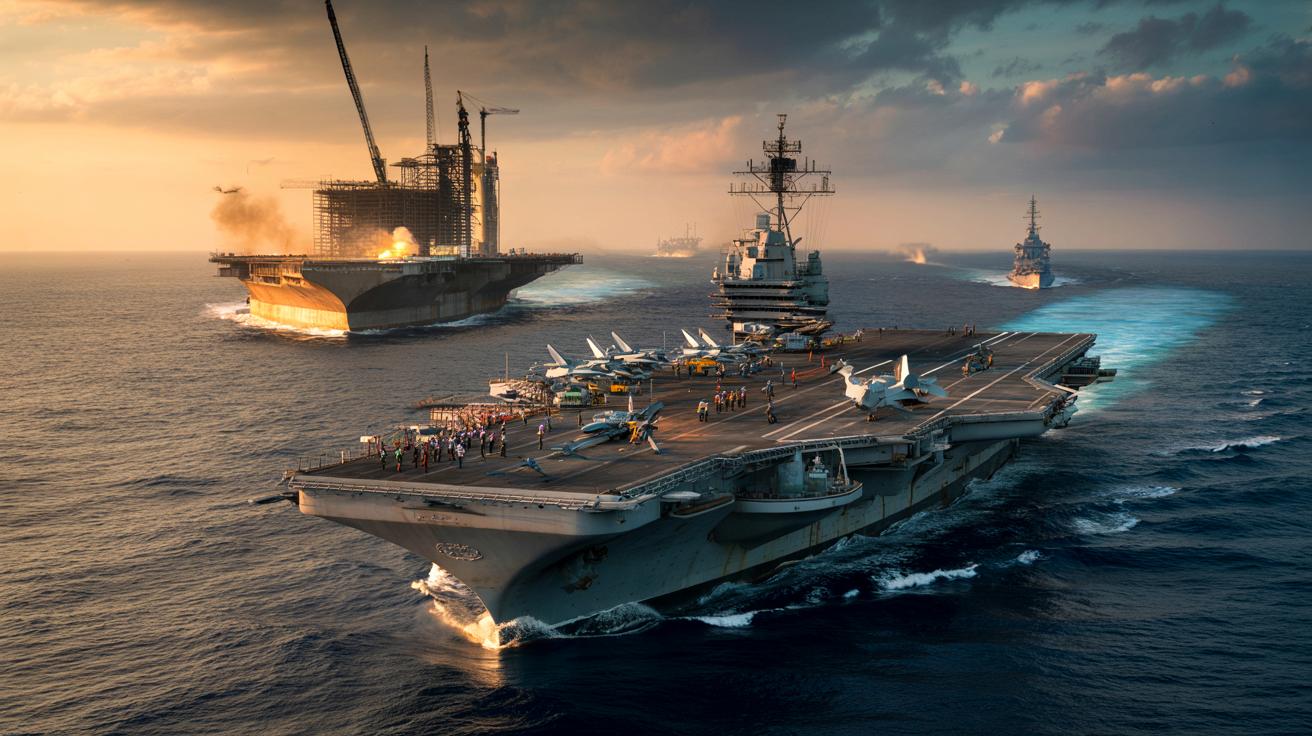
On the shipyard pier at Newport News, you feel the scale before you see it. Floodlights wash over a forest of cranes, steel plates, and scaffolding that climbs into the misty Virginia sky. Below, hundreds of workers in hard hats move around the growing hull of the USS John F. Kennedy, a 100,000-ton argument in favor of American power, bolted together piece by piece.
Far across the Atlantic, her older sister, the USS Gerald R. Ford, is sliding toward her first real taste of combat duty, carrying drones, fighter jets, and a message that reaches Moscow, Beijing, and Tehran in the same breath.
Two ships. One strategy. An entire world watching, nervous.
Two floating cities, one escalating message
From a distance, a Ford-class carrier looks almost serene. A gray rectangle on the water, a tiny control tower, some specks of movement on deck. Up close, it feels less like a ship and more like a floating city designed for war. You smell jet fuel, hear the echo of grinders on steel, and feel the bass thud of turbines under your feet.
The U.S. Navy’s decision to accelerate work on the USS John F. Kennedy, just as USS Gerald R. Ford edges toward real combat missions, is not a technical detail. It’s a loud, unmistakable signal. The world’s biggest navy isn’t just maintaining its lead. It’s pressing the gas pedal.
Inside the cavernous bow section of the Kennedy, welders crouch under showers of sparks, joining steel plates the size of small houses. A supervisor points to a block weighing hundreds of tons being lowered into place and mutters that the “schedule just got tighter… again.”
The reason is not a secret. With global flashpoints multiplying from the South China Sea to the Red Sea, the Pentagon has quietly shaved months off planned milestones. The Ford has already spent time near Israel and Eastern Europe as a kind of diplomatic warning shot. Each deployment becomes a case study: Watch what happens when a single carrier group shows up offshore and local calculations change overnight.
There’s a simple, cold logic behind this acceleration. Carriers are not just war machines, they’re mobile pressure points. A Ford-class hull sailing into a contested region alters every conversation inside foreign ministries and war rooms.
In Washington, the argument goes like this: as Russia hammers Ukraine, China shadows Taiwan, and Iran tests the edges of regional order, backing off would invite trouble. Pushing ahead with Kennedy while Ford heads toward potential combat is supposed to close off that temptation. Of course, that same show of strength feeds another narrative abroad — the one that frames the U.S. as an empire tightening its grip, not a guardian keeping sea lanes open.
The careful choreography of dominance and doubt
One quiet rule shapes every carrier deployment: leave just enough doubt. U.S. officials rarely say exactly how far a ship might go in a crisis. They talk about deterrence, stability, reassurance. But the choreography is precise. Ford moves closer to a tense coast. Kennedy’s construction photos appear in defense blogs. Budget hearings on Capitol Hill tease future strike groups.
Behind those decisions is a method that blends logistics with psychology. Planners map out potential conflicts, identify choke points like the Taiwan Strait or the Strait of Hormuz, then match them to carrier availability years in advance. The acceleration of Kennedy slots another massive piece into that global puzzle, shrinking gaps where adversaries might think, “Now is our moment.”
If you’ve ever watched national security debates on TV and felt lost in acronyms and jargon, you’re not alone. We’ve all been there, that moment when a senator says “carrier strike group” and the ticker scrolls on before you catch the meaning. Behind that neat phrase sits an ecosystem of people and money.
Every Ford-class deployment means thousands of sailors gone from home for months, tens of thousands of supply contracts, and billions of dollars in operating costs. A single jet launch off the Ford’s electromagnetic catapult pulls on a global supply chain that touches small machine shops in Ohio, electronics factories in Arizona, and port workers in Spain or Japan. When the U.S. accelerates the Kennedy, it doesn’t just reshape military timelines. It jolts local economies, election debates, even the job prospects of teenagers wondering whether to join the Navy.
The plain truth is that a carrier is as much a political tool as a military one. You don’t spend more than $13 billion per ship just for steel and engines. You spend it for presence, headlines, leverage at negotiating tables.
Critics inside and outside the U.S. argue that this bet looks shaky in an age of hypersonic missiles and cheap attack drones. They ask whether pouring resources into colossal targets is wise when adversaries are investing in ways to sink them from thousands of miles away. Supporters answer that pulling back from carrier dominance would signal retreat at the very moment rivals are testing the boundaries. *Between those two positions stretches the real battlefield: fear of vulnerability on one side, fear of irrelevance on the other.*
What this arms race means for the rest of us
For all the talk of strategy, this story lands in very ordinary places. In a coastal Greek town, a fisherman who has started seeing more U.S. ships near his usual routes quietly worries about what happens if missiles fly one day. In a Polish village near a NATO logistics hub, parents weigh whether to send their kids to school if tensions spike whenever a major U.S. asset like Ford appears in regional waters.
One simple way to read the carrier race is this: wherever these ships go, insurance prices, shipping routes, and local nerves move with them. When Ford is earmarked for combat deployment and Kennedy speeds up, global freight companies adjust risk models. Investors reprice energy flows. Governments recalibrate how loudly they’ll criticize Washington or Beijing this week. The steel going into Kennedy’s hull ripples through your grocery bill more than you might think.
People watching from outside the U.S. often feel whiplash. One day America talks about climate commitments and cutting defense waste. Next day it parades a carrier strike group through contested waters with an unmistakable flex.
There’s a quiet fatigue here that rarely makes it into official speeches. Citizens from Manila to Marseille ask why they should live with the fallout of great-power signaling they never voted on. Let’s be honest: nobody really reads 800-page defense budget documents every single day. They just feel the result when fuel prices jump or when their government suddenly buys more submarines “just in case.” In that gap between policy language and daily life, trust erodes.
“Every time a U.S. carrier steams into a tense region, our phones light up,” a European diplomat told me recently. “Allies want reassurance. Neighbors want explanations. Rivals want to test the edges. The sea looks calm, but the politics are anything but.”
- Rising tensions in strategic chokepoints
From the Black Sea to the South China Sea, each Ford-class move pressures adversaries to respond, often with their own deployments. - Growing unease among U.S. allies
European and Asian partners depend on the U.S. shield, yet quietly worry that being tied to these giant symbols of power makes them automatic targets. - Domestic debate over the price tag
As Kennedy accelerates and talk of a third Ford-class carrier grows, American voters are asking what else could be done with tens of billions of dollars.
A future written in steel, debt, and doubt
The story of the USS Gerald R. Ford and USS John F. Kennedy is less about metal than mindset. It’s the story of a country that still believes its influence rides on gray decks and roaring catapults, even as the world fragments into cyber wars, proxy conflicts, and economic chokeholds. As construction crews race to close Kennedy’s hull and planners push Ford closer to real combat, the U.S. is doubling down on a bet that big ships still shape history.
Some see reassurance in that bet: a familiar anchor in a chaotic era. Others feel only a knot in the stomach, sensing that every new launch deepens rifts with China, Russia, and even skeptical allies. The truth is, neither side can fully prove they’re right yet. The answer will arrive in a crisis no one really wants, when a president looks at a map, sees a carrier group in range, and has to decide what that power is actually for.
| Key point | Detail | Value for the reader |
|---|---|---|
| U.S. accelerates USS Kennedy | Construction timelines tightened to bring the second Ford-class carrier into service faster | Helps you grasp why headlines about shipyards and budgets signal deeper strategic shifts |
| USS Ford approaches combat role | First of its class moving from trials and deterrence patrols toward real-world missions | Shows how a single ship can influence global tensions, energy prices, and diplomacy |
| Global rifts and domestic debate | Allies, rivals, and U.S. voters question the cost, risks, and purpose of carrier dominance | Gives context to political arguments you hear about defense spending and world order |
FAQ:
- Question 1Why is the U.S. speeding up construction of the USS John F. Kennedy now?Because planners see a tightening window of risk. With Russia active in Europe, China building up in the Pacific, and Iran stirring the Middle East, the Navy wants fewer gaps in carrier coverage, so Kennedy is being pushed into the lineup faster.
- Question 2What makes the Ford-class carriers different from older U.S. carriers?They use electromagnetic catapults, advanced arresting gear, a redesigned island, and a nuclear plant that can power more sorties and future weapons like high-energy lasers, all meant to launch more aircraft with fewer crew over longer periods.
- Question 3Are these massive carriers becoming obsolete targets for modern missiles?That’s the core of the current debate. Adversaries have invested in long-range anti-ship and hypersonic missiles, yet the U.S. argues that layered defenses, electronic warfare, and constant movement still give carriers a fighting chance and huge deterrent value.
- Question 4How does all this affect civilians outside the U.S.?Carrier movements can shift shipping lanes, raise or lower regional tensions, and influence energy and insurance costs, so people may feel the impact in prices, local security policies, or new bases and training ranges in their countries.
- Question 5Could the U.S. choose a different path than building more giant carriers?Yes. Some strategists push for smaller, more numerous ships, submarines, and unmanned systems. The acceleration of Kennedy shows that, for now, Washington still believes these giant decks remain central to American power projection.